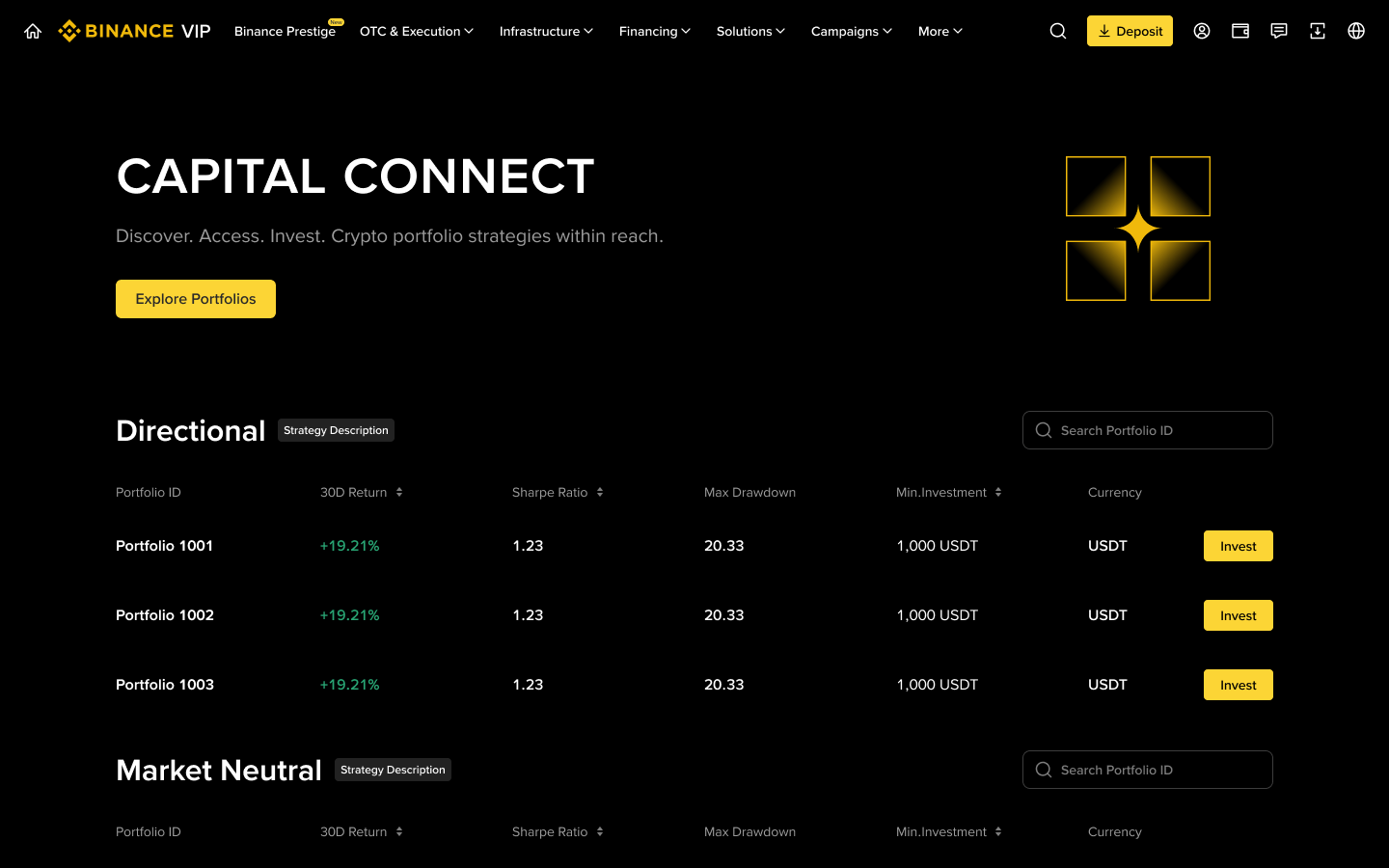
Binance is reworking how institutional capital finds its way into crypto strategies. The exchange has relaunched Capital Connect, this time built directly on top of its Portfolio Accounts infrastructure, aiming to fix what it sees as a fragmented and inefficient investment discovery process.
The update shifts Capital Connect from a networking-style tool into something closer to a structured marketplace, where investors can evaluate strategies, compare performance and connect with trading teams inside a controlled environment.
At a high level, Binance is trying to bring parts of traditional asset management workflow into crypto — without relying on the informal channels that still dominate the space.
What actually changed?
The key difference is the integration with Portfolio Accounts, Binance’s omnibus account system for institutional trading. Instead of just listing strategies or profiles, trading teams now operate directly through this infrastructure before they are visible to investors.
That means strategies come with an operational track record attached, rather than just a pitch. Investors can browse performance data, risk metrics and allocation terms in a more standardized format.
Importantly, assets remain held on Binance and cannot be withdrawn by trading teams. That removes one of the bigger concerns institutions tend to have when allocating capital in less structured environments.
Investor Takeaway
Why this matters for institutional crypto
Institutional participation in crypto is still uneven. While capital has entered through ETFs and large funds, direct allocation into trading strategies remains fragmented.
Much of that process still happens through introductions, private networks or opaque deal flow. That creates inefficiencies — and limits visibility for both investors and trading teams.
Capital Connect is designed to reduce that friction. Investors can filter strategies by metrics such as returns, Sharpe ratio, drawdown, and minimum investment terms, while trading teams can build visibility through performance rather than marketing.
The goal is to make discovery more systematic and less relationship-driven, which is how traditional markets tend to operate.
How the matching process works
The platform introduces a controlled interaction model. Investors and trading teams remain anonymous at first. Only after a connection is accepted does information get shared.
This approach is meant to protect both sides, while still allowing for structured deal flow. It also reflects how institutional introductions often work in traditional finance — with screening before disclosure.
Access is restricted. Investors need to meet certain thresholds, such as VIP status or holding at least $1 million in assets, while trading teams must meet licensing or regulatory requirements depending on jurisdiction.
Investor Takeaway
Where this fits in the bigger trend
The relaunch reflects a broader shift in crypto infrastructure. As the market matures, exchanges are trying to move beyond pure trading venues and into capital allocation platforms.
That means borrowing ideas from traditional finance — portfolio structures, standardized reporting, controlled onboarding — and adapting them to a crypto-native environment.
Portfolio Accounts are a step in that direction. By combining execution, custody and strategy management under one framework, Binance is trying to reduce the operational complexity that has slowed institutional adoption.
The question is whether this kind of structure can scale across jurisdictions and regulatory environments. Institutional crypto remains highly dependent on local compliance rules, and that could limit how widely products like Capital Connect can expand.
Still, the direction is clear. The next phase of crypto growth is less about access to assets and more about how capital is deployed — and platforms that can organize that process are likely to play a bigger role.
