Onchain finance has enough blockchains, wallets, stablecoins and tokenized assets to scale. What it still lacks is a shared coordination layer for identity, compliance, messaging and transaction approval across institutions, wallets, agents and jurisdictions.
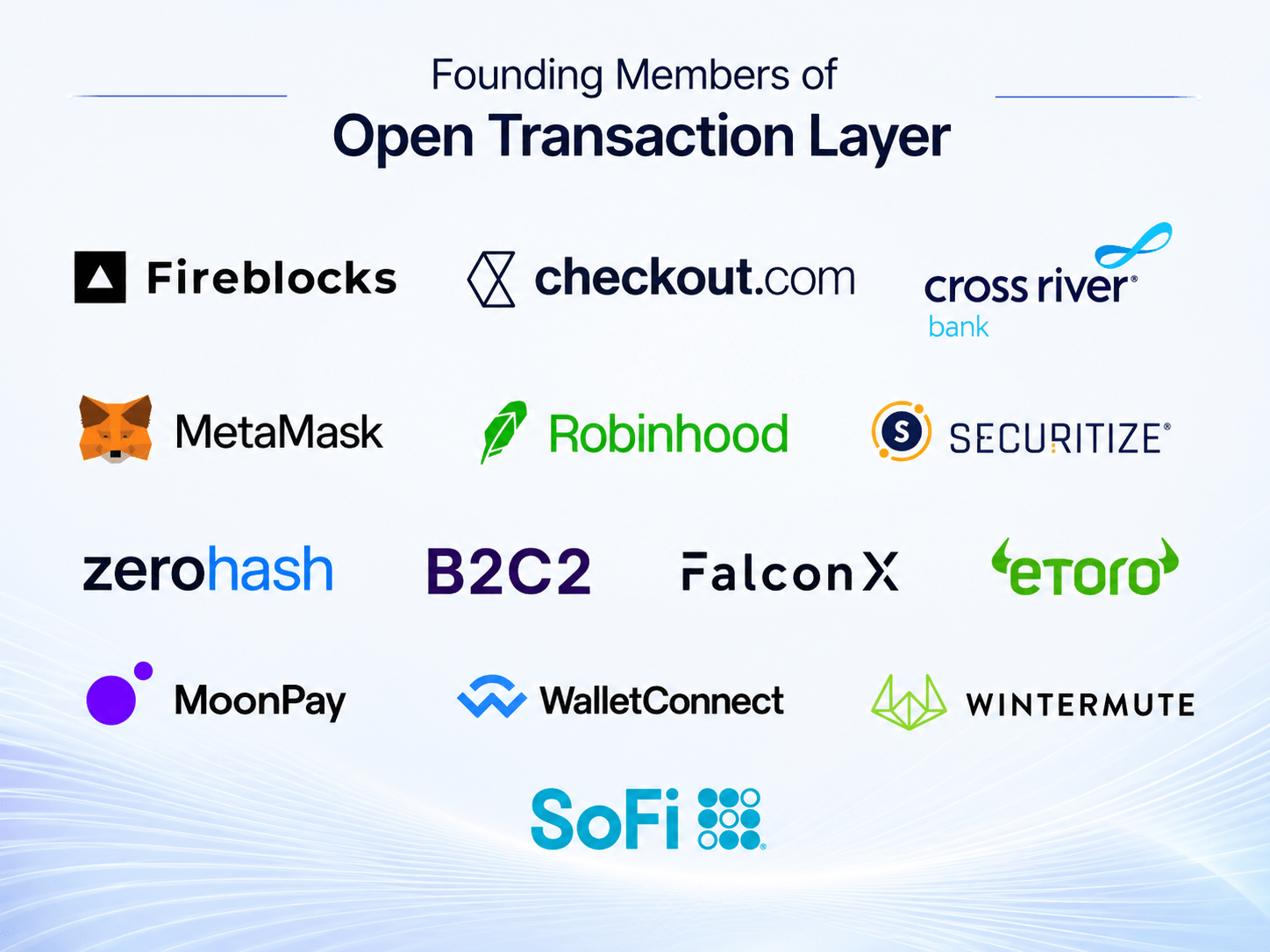
That is the gap Open Transaction Layer is trying to close. The new initiative launched with a founding alliance that includes Fireblocks, Checkout.com, Cross River Bank, MetaMask, Robinhood, Securitize, zerohash, B2C2, FalconX, eToro, MoonPay, WalletConnect, Wintermute, SoFi and several blockchain foundations.
OTL is an open protocol stack designed to coordinate onchain transactions securely and compliantly across counterparties. The specifications cover identity, session, transport and messaging layers, with applications sitting above them. The goal is to let institutions find counterparties, exchange transaction context, establish compliance and settle transactions across wallets, chains and jurisdictions without building bespoke bilateral integrations each time.
The launch matters because the digital asset industry is entering a phase where infrastructure fragmentation is becoming more expensive than blockchain throughput itself.
Stablecoin activity alone has already reached institutional scale. Visa’s onchain analytics data shows more than $51 trillion in stablecoin transaction volume over the past 12 months, while RWA.xyz data shows about $299 billion in stablecoin value and more than 241 million stablecoin holders. Tokenized real-world assets have also grown into a multi-tens-of-billions market, with RWA.xyz showing more than $26 billion in distributed asset value.
The problem is no longer whether value can move onchain. The problem is whether regulated institutions can coordinate that movement safely, repeatedly and across counterparties they do not already know.
OTL Targets The Missing Layer Between Wallets, Institutions And Agents
Open Transaction Layer defines shared protocols for identity, messaging and transaction coordination across institutions, unhosted wallets and AI agents.
The founding members reflect the scope of the problem. OTL includes financial institutions, payment companies, crypto infrastructure providers, wallets, liquidity firms, tokenization platforms and blockchain foundations.
The founding group includes Fireblocks, Checkout.com, Cross River Bank, MetaMask, Robinhood, Securitize, zerohash, B2C2, FalconX, eToro, MoonPay, Orbital, Privy + Bridge, SoFi, Taptap Send, Tazapay, Triple-A, WalletConnect, Wintermute, Xendit, Zengo and Zerocap. The Blockchain Payments Consortium also participates, bringing foundations including TON, Stellar, Polygon, Monad, Solana, Sui and Mysten Labs.
The commercial reason is clear. Every institution running onchain operations currently has to solve the same coordination problems separately.
Those problems include:
- identifying counterparties
- attributing wallets to controlling entities
- exchanging payment or settlement context
- checking compliance requirements
- coordinating transaction approval
- reaching unhosted wallets
- interacting with AI agents safely
- settling across different chains and jurisdictions
Without a shared layer, every new counterparty, wallet type, asset, use case or jurisdiction creates another integration project. That creates what Fireblocks called “integration sprawl.”
Idan Ofrat, Co-Founder and Chief Product Officer at Fireblocks, commented, “Regulated institutions have to build bespoke connections to orchestrate their digital asset operations end-to-end. The result is integration sprawl and parallel systems that don’t reconcile.”
He added, “A standard like this isn’t something any single vendor can ship. It only works as an open initiative, built by the people implementing it.”
Why This Is Not Another Blockchain Standard
The industry already has plenty of chains, wallets, bridges and messaging protocols. OTL is different because it is not trying to become a new settlement rail.
Instead, it attempts to standardize the process around the transaction.
OTL draws on existing standards including W3C decentralized identifiers, IVMS101, ISO 20022 and CAIP-19. It organizes them into a modular architecture covering the full transaction lifecycle: discovery, coordination, compliance and settlement.
That distinction matters for institutions.
A bank or brokerage does not only need to know that a blockchain can settle a transfer. It needs to know:
- who the counterparty is
- whether the wallet is permitted
- what transaction context is attached
- whether the payment request is authentic
- whether the transaction can be approved or rejected before funds move
- whether audit and compliance records exist
These are operational questions, not ideological crypto questions.
Max Rotham, VP of Crypto at Checkout.com, commented, “Open Transaction Layer reflects the kind of open, interoperable standards the industry needs as commerce becomes more programmable, tokenized, and, over time, agent-led.”
He added that merchants and institutions need clearer ways to identify counterparties, exchange transaction context and coordinate securely across wallets, chains and jurisdictions as onchain activity scales.
The Agentic Finance Angle
One of the most important parts of the announcement is the reference to AI agents.
OTL is not only designed for institutions and wallets. It also explicitly covers agents.
That matters because financial platforms are beginning to open infrastructure to AI-driven actors. Robinhood recently announced Agentic Trading and Agentic Credit Card products using Model Context Protocol servers, allowing customers to connect AI agents to trading and spending environments with controls. OTL sits in the same wider shift: financial systems are preparing for non-human transaction initiators.
That creates a difficult infrastructure problem.
If an AI agent initiates a payment, trade, settlement instruction or wallet interaction, institutions need a way to know:
- which user authorized the agent
- what limits apply
- what context the agent supplied
- whether the receiving wallet is acceptable
- whether the transaction can be paused or rejected
- who is responsible if something goes wrong
Without a shared coordination layer, every platform will build its own system for agent identity and permissioning. That would produce the same fragmentation already seen across wallets and institutional crypto integrations.
This is why OTL’s founding membership matters. It includes consumer platforms, wallets, payments firms and institutional infrastructure providers. If agentic finance becomes real, coordination standards will be as important as execution rails.
The Stablecoin And Tokenization Use Case
The most immediate commercial use case for OTL may be stablecoin payments and tokenized assets.
Stablecoins already move at massive scale, but raw transaction volume can be misleading. McKinsey has noted that much of the activity often cited in stablecoin volume statistics is not necessarily tied to real-world payments. That does not weaken the case for infrastructure. It strengthens it.
If stablecoins are to move from crypto trading and treasury flows into mainstream payments, institutions need better coordination around identity, compliance and transaction context.
A merchant payment, remittance, payroll transfer or institutional settlement is not just a token transfer. It requires metadata, counterparties, compliance checks, refund logic, reconciliation and reporting.
The same applies to tokenized real-world assets.
Tokenized funds, Treasuries, private credit, securities and collateral instruments cannot scale inside institutional finance if each issuer, wallet, custodian, broker and payment provider must build bespoke connections.
RWA.xyz currently tracks more than $26 billion in tokenized real-world asset value, excluding stablecoins. It also tracks hundreds of thousands of asset holders. Those numbers are still small compared with traditional capital markets, but they are large enough to expose the coordination problem.
As tokenized assets grow, firms will need standards for:
- investor identity
- eligibility checks
- transfer restrictions
- wallet attribution
- settlement instructions
- corporate actions
- redemption workflows
OTL’s value proposition is that these coordination problems should not be rebuilt from scratch by every issuer, wallet, broker and custodian.
What This Means For Brokers And Fintech Platforms
For brokers, exchanges and fintech platforms, OTL should be understood as infrastructure that could reduce the cost of entering onchain finance.
Today, a broker that wants to support tokenized assets, stablecoin payments or wallet-based settlement often faces a long chain of operational questions before launch.
Those questions include:
- How do we identify external wallets?
- How do we verify counterparties?
- How do we comply with travel rule expectations?
- How do we exchange transaction instructions with another institution?
- How do we handle settlement across chains?
- How do we provide auditability?
- How do we support future AI-agent interactions?
If every provider answers those questions differently, the market remains fragmented. Integration costs stay high. Product launches slow down. Compliance teams become blockers. Counterparty onboarding remains manual.
That is the business problem OTL is trying to solve.
For brokerage executives, the practical implication is simple: onchain products may become easier to integrate if coordination becomes standardized.
This could support new product categories including:
- stablecoin deposits and withdrawals
- tokenized money market funds
- onchain settlement accounts
- tokenized securities access
- agent-driven payment workflows
- cross-border payout products
- collateral movement between venues
The winners will likely be firms that adopt standards early while keeping control over risk, compliance and user experience.
Why Fireblocks’ Role Matters
Fireblocks is one of the central names in the OTL launch because of its existing digital asset infrastructure footprint.
The company says thousands of organizations use Fireblocks and that its infrastructure has secured more than $10 trillion in digital asset transactions across more than 120 blockchains. That gives it direct visibility into the coordination pain institutions face when operating across wallets, chains and counterparties.
Fireblocks’ involvement also gives OTL credibility with institutional users. Standards only matter if market participants actually implement them. A protocol backed by infrastructure providers, wallets, payment companies and trading firms has a better chance of adoption than a vendor-only initiative.
The same logic applies to Checkout.com, Robinhood, MetaMask, Securitize and zerohash.
Checkout.com brings payments and merchant infrastructure. Robinhood brings consumer finance and agentic finance relevance. MetaMask brings wallet distribution. Securitize brings tokenized securities experience. zerohash brings embedded crypto infrastructure.
That mix is important because the coordination problem touches every part of the transaction lifecycle.
The Risk: Standards Without Adoption
The main risk for OTL is obvious. Financial markets have seen many proposed standards fail because adoption remained partial.
A coordination layer only works if enough market participants use it.
If large institutions, wallets and platforms continue building closed bilateral systems, OTL could become another well-designed specification with limited network effects.
The opposite is also true. If enough firms adopt it, OTL could become a foundational layer for compliant onchain transactions in the same way FIX became foundational for electronic trading workflows.
The comparison is not perfect, but the market logic is similar.
FIX did not become important because one vendor owned it. It became important because enough market participants needed a shared way to communicate trading instructions. OTL is making the same argument for onchain finance.
That is why the founding alliance matters as much as the technical documentation.
The industry is not short of protocols. It is short of coordination agreements that large institutions, wallets and fintech platforms are willing to use.
If OTL succeeds, the effect may not be visible to end users. Like many infrastructure standards, it would sit behind products and make them easier to launch, scale and connect.
That is precisely why it could matter.
Takeaway
Open Transaction Layer is trying to solve one of the least glamorous but most important problems in onchain finance: transaction coordination. The industry has settlement rails, wallets, stablecoins and tokenized assets, but institutions still lack a common way to identify counterparties, exchange compliance context and coordinate transactions across wallets, chains and jurisdictions.
The founding group includes major names across infrastructure, payments, wallets, trading and consumer finance, including Fireblocks, Checkout.com, Cross River Bank, MetaMask, Robinhood, Securitize and zerohash. That breadth matters because coordination standards only work when the industry adopts them collectively.
For brokers, fintech platforms and payment providers, the practical question is whether OTL can reduce the cost and complexity of launching onchain products. If it gains adoption, it could become a hidden infrastructure layer behind stablecoin payments, tokenized assets, wallet-based settlement and agentic finance workflows.
Infographic: Open Transaction Layer By The Numbers
| Metric | Figure | Why It Matters |
|---|---|---|
| Founding participant categories | Institutions, wallets, payment firms, infrastructure providers, trading firms, blockchain foundations | Shows OTL is targeting transaction coordination across the full onchain finance stack |
| Technical layers | Identity, session, transport, messaging, applications | Covers coordination around transactions rather than replacing settlement rails |
| Existing standards referenced | W3C DIDs, IVMS101, ISO 20022, CAIP-19 | OTL builds around existing standards instead of starting from scratch |
| Stablecoin transaction volume | $51T+ over 12 months | Shows onchain settlement activity is already at institutional scale |
| Stablecoin value tracked by RWA.xyz | ~$299B | Stablecoins are the most mature onchain payment and settlement asset category |
| Stablecoin holders tracked by RWA.xyz | 241M+ | Large user base increases need for wallet and counterparty coordination |
| Tokenized real-world asset value | $26B+ | Tokenized funds and assets need identity, transfer and compliance coordination |
| Fireblocks transaction infrastructure footprint | $10T+ across 120+ blockchains | Fireblocks’ role gives OTL direct institutional infrastructure relevance |
