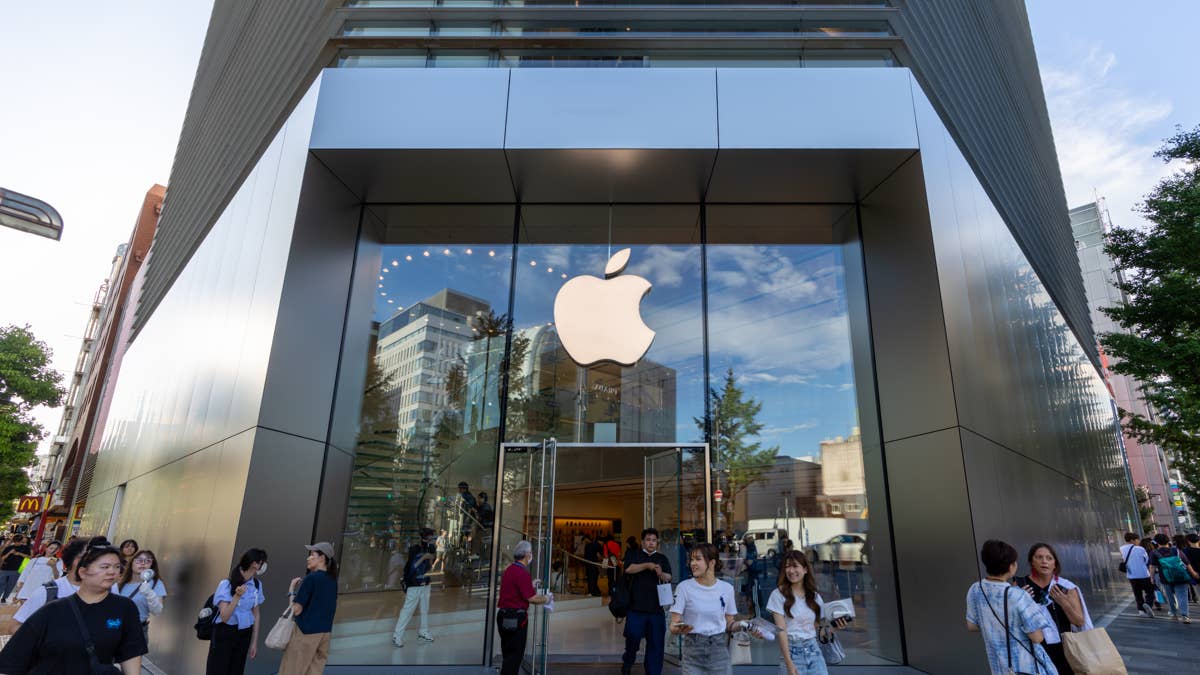
Apple has spent years trying to make artificial intelligence a reason for consumers to buy new devices.
That strategy has become more important as rivals, including Google, Microsoft, OpenAI, and Meta, move quickly with consumer-facing AI tools.
For Apple, the opportunity is clear. If AI makes the iPhone, iPad, and Mac more useful, it could help push users to upgrade and give Apple’s services business another long-term growth driver.
And at the recent Worldwide Developers Conference (WWDC) 2026, the company launched several new upgrades, including updated Apple intelligence and a new Siri AI, as covered here by TheStreet.
But the same AI boom is creating problems for the iPhone maker.
The surge in demand for artificial intelligence infrastructure is pushing up the cost of memory and storage chips, key components in phones, tablets, and computers.
That means AI may not only help Apple sell new devices, but also make those devices more expensive for shoppers.
Apple CEO Tim Cook recently told the Wall Street Journal that the company will need to raise prices to offset rising memory costs.
Now Bank of America is weighing in on what that means for Apple stock.
Bank of America keeps bullish Apple stock view
In a June 18 note shared with TheStreet, Bank of America analyst Wamsi Mohan reiterated his Buy rating on Apple stock and kept a $380 price target.
That target implies 28.4% upside from the $295.95 Apple share price used in the note.
The call comes shortly after TheStreet reported that Goldman Sachs reset its Apple stock forecast after WWDC, as Wall Street weighed whether Apple’s new Siri AI and Apple Intelligence updates could support a stronger upgrade cycle.
More Apple:
- Goldman Sachs resets Apple stock forecast after WWDC
- Apple answers Wall Street’s biggest AI concern
- Morgan Stanley revamps Apple stock target after key event
However, Bank of America’s latest note focuses on a different part of the Apple story: pricing.
Mohan said Apple’s pricing strategy is becoming the next key lever as the company tries to offset higher component costs without damaging demand.
“We had already expected Apple to raise pricing and had reflected about a $100 price increase in our prior estimates,” Mohan wrote.
After Cook’s comments and the continued rise in memory pricing, BofA now assumes an additional $100 increase on the Pro and Pro Max iPhone models.
The firm left its assumptions unchanged for the base iPhone model. It also left its iPhone Air average selling price assumption unchanged because the model already reflected a $100 price increase.
That matters because Apple may be trying to protect demand at the lower end while charging more for premium models, where buyers may be less price-sensitive.
winhorse / Getty Images
Apple price hikes could hit more than iPhones
Bank of America does not expect pricing changes to be limited to iPhones.
The firm said it also assumes prices for Mac and iPad products will rise. At the same time, BofA lowered its unit demand estimates marginally across all product categories.
That creates a careful balance for Apple.
Higher prices can help protect revenue and offset rising component costs. But they can also test how much more consumers are willing to pay, especially as many households are already dealing with elevated costs across food, travel, housing, and services.
For Apple, the pricing issue is especially important because the iPhone remains the company’s most important product.
A higher price on Pro models could lift average selling prices if demand holds. But if consumers delay upgrades, trade down to cheaper models, or hold on to older devices longer, the benefit could be smaller.
That is why Apple’s AI strategy still matters.
TheStreet previously noted that Apple faced a Siri moment it could not afford to miss, because the company needs to prove that AI can make its devices feel more necessary.
If Apple can make AI features compelling enough, higher prices may be easier to defend. If not, price increases could become another reason for consumers to wait.
Apple gross margin will be impacted
Bank of America said Apple is relatively well-positioned on the supply side.
The firm pointed to Apple’s scale, long-term relationships with memory suppliers, and balance sheet as key advantages in securing longer-term supply.
That is important because memory has become a major pressure point across the technology industry. AI data centers require large amounts of memory, and that demand is competing with consumer electronics companies for supply.
BofA expects Apple to offset some of the component pressure through other parts of the bill of materials, recycled or recovered materials, lower overhead, and supply chain efficiencies.
Still, the firm sees some margin pressure.
Mohan said there could be an additional 100 basis points of gross margin headwinds in products. Service margins, however, are expected to remain stable, with potential upside working to offset this loss.
Apple’s services business includes the App Store, iCloud, Apple Music, Apple TV+, AppleCare, payments, and other subscription offerings. It is more recurring than hardware sales and has become a key part of the company’s profit story.
This makes Apple’s services particularly interesting to Wall Street.
BofA also adjusted its estimates.
The firm now expects fiscal 2026 revenue of $469.8 billion and earnings of $8.63 per share, up from its prior estimates of $468.7 billion and $8.61 per share.
For fiscal 2027, BofA raised its revenue estimate to $535 billion from $531.4 billion, but lowered its EPS estimate to $9.89 from $9.96.
Bank of America flags risks to Apple stock forecast
Bank of America remains bullish on Apple, but the outlook still carries risks.
The firm said a weaker iPhone cycle tied to consumer spending could hurt Apple. That risk becomes more important if shoppers start seeing higher prices across iPhones, Macs, and iPads.
BofA also flagged the risk of a weaker near-term services trajectory, especially if App Store and licensing revenue decelerate.
Execution on agentic Siri is another key risk.
That puts Apple’s AI rollout at the center of both the company’s growth opportunity and its risk profile.
Apple needs AI features to be useful enough to drive upgrades, but it also needs to manage the higher costs that AI demand is creating across the memory supply chain.
Other risks include:
- iPads and Macs reverting to pre-COVID demand levels
- stronger dollar
- antitrust lawsuits
- potential trade conflicts, tariffs
- longer iPhone replacement cycles
- smartphone commoditization
- stronger tablet competition
- need to maintain its pace of product innovation.
So while higher prices may help Apple protect margins and revenue, they also raise the bar for product execution.
Apple’s next test may not be whether it can charge more. It may be whether consumers believe the next iPhone, iPad, or Mac is worth paying more for.
Related: Warren Buffett’s successor Greg Abel makes another $10 billion bet
